
PRP Hair Treatment: How It Works, Sessions, Results and Who May Benefit
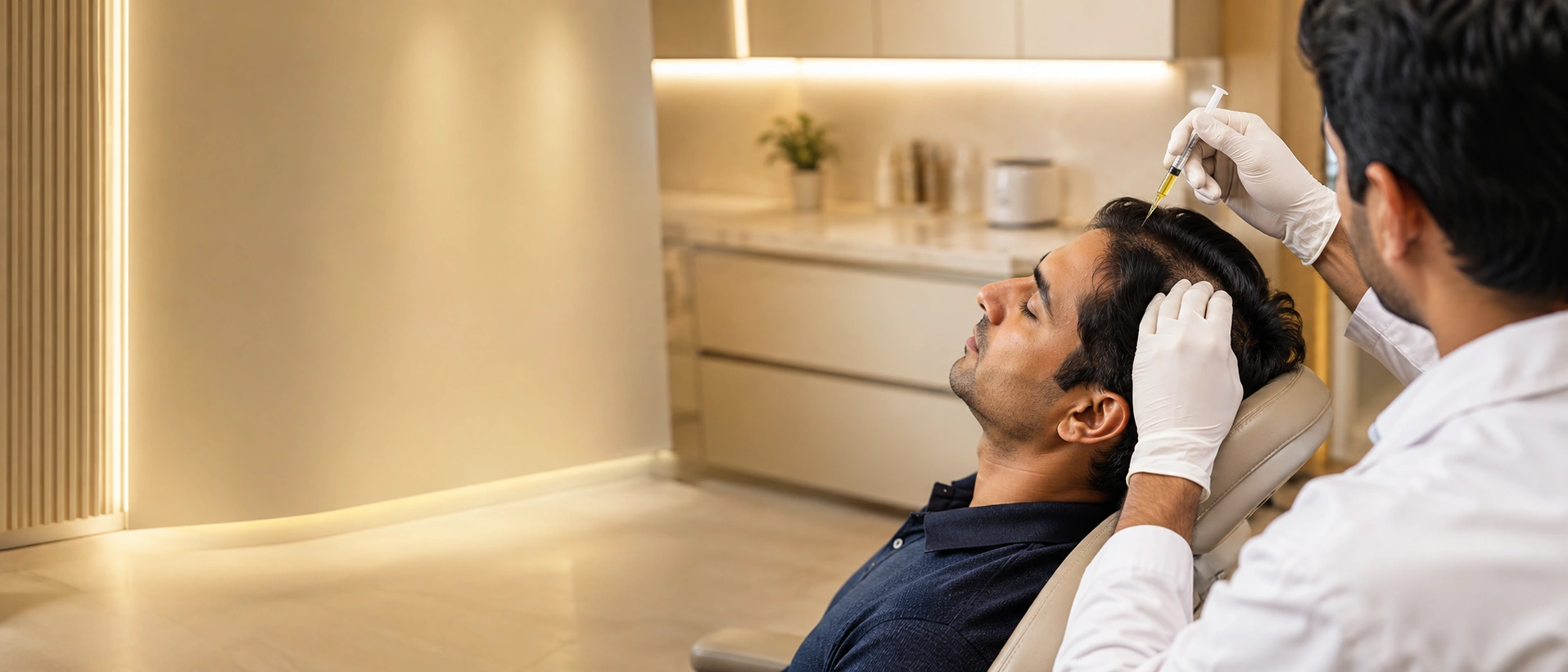
Platelet-rich plasma, commonly called PRP, is a regenerative treatment used in dermatology to support selected types of hair loss. It uses a concentrated portion of the patient’s own blood, prepared in a centrifuge, and injects it into targeted areas of the scalp. The goal is not to create new hair follicles from nothing. Instead, PRP is used to support existing follicles that are still alive but may be miniaturising or producing weaker, thinner strands.
For people searching for PRP hair treatment in Udaipur, understanding what the procedure can and cannot do is important. PRP may be considered in pattern hair loss and some cases of diffuse thinning, but it is not a universal treatment for every reason for hair fall. A dermatologist should first identify the underlying diagnosis, review medical history, inspect the scalp and decide whether PRP is appropriate.
What Is PRP Hair Treatment?
PRP treatment begins with a small blood sample taken from the patient. The blood is placed in a centrifuge, which separates different components based on density. A platelet-rich portion is then prepared for scalp injection. Platelets contain growth factors and signalling proteins that are involved in tissue repair and cell communication.
When PRP is used for hair loss, these concentrated platelets are injected into areas where hair is thinning. The treatment is generally performed in a clinic setting and often takes less than an hour, although exact timing varies according to the protocol and treatment area.
How PRP May Support Hair Growth
Hair follicles repeatedly move through growth, transition and resting phases. In androgenetic alopecia, follicles gradually become smaller and produce finer hair. PRP is used with the aim of supporting follicular activity and improving the quality of existing hair. Research suggests that selected patients may experience improvements in hair density, shaft thickness or shedding, although response varies.
PRP is not equivalent to a hair transplant. A hair transplant in Udaipur moves follicles from a donor zone to a thinning or bald area. PRP does not redistribute follicles. It is more often considered as a non-surgical treatment for suitable candidates or as a supportive option around other hair-restoration plans.
Who May Be a Good Candidate?
PRP may be discussed for men and women with early or moderate pattern hair loss, people with progressive thinning and selected patients who want a non-surgical approach. It may also be used as part of a broader plan after a diagnosis has been established.
However, PRP is not automatically suitable for sudden unexplained shedding, scarring alopecia, untreated scalp disease or hair loss caused by nutritional, hormonal or systemic conditions. These situations may require other investigations or treatment first.
What Happens During a PRP Session?
- Assessment: The scalp and hair-loss pattern are reviewed.
- Blood collection: A small sample is drawn from a vein.
- Centrifugation: The blood is processed to isolate platelet-rich plasma.
- Scalp preparation: The treatment area is cleaned; pain-control measures may be used.
- Injection: PRP is delivered into multiple points across the selected scalp region.
- Aftercare: Patients receive instructions for the first day or two after treatment.
How Many PRP Sessions Are Usually Needed?
There is no single protocol that applies to every patient. Many treatment plans use a short initial series followed by maintenance sessions, but the schedule depends on the diagnosis, severity, response and clinician’s protocol. Hair growth is slow, so judging results after only a few days or weeks is unrealistic.
| Stage | Typical Goal | What Patients May Notice |
|---|---|---|
| Initial sessions | Begin follicular stimulation | Usually little visible change immediately |
| Early follow-up | Assess shedding and scalp response | Some patients report reduced shedding |
| Several months | Evaluate density and thickness | Possible improvement in hair calibre or coverage |
| Maintenance | Support ongoing results | Frequency depends on individual response |
When Can Results Be Expected?
Hair follicles need time to move through their biological cycle. Some patients notice reduced shedding before they notice visible density changes. Meaningful photographic comparison is usually more useful over several months than day-to-day mirror checking. Consistent lighting, angle and hairstyle should be used when comparing progress.
Results are not guaranteed. Age, genetics, diagnosis, duration of hair loss, follicle miniaturisation, medication use, nutrition and treatment adherence can all affect the outcome.
PRP vs Minoxidil vs Hair Transplant
| Option | Type | Best Considered For | Key Limitation |
|---|---|---|---|
| PRP | Clinic-based regenerative treatment | Selected thinning hair with viable follicles | Requires multiple sessions; variable response |
| Minoxidil | Topical/oral medication under medical advice | Selected forms of pattern hair loss | Ongoing use may be needed |
| Hair transplant | Surgical redistribution of follicles | Stable bald or thinning areas with donor supply | Procedure, recovery and donor limitations |
For more context, read our hair regrowth treatment in Udaipur and hair fall treatment pages.
Is PRP Painful?
Patients usually describe brief pinching or pressure during scalp injections. Sensitivity varies from person to person. Clinics may use cooling, topical anaesthetic or other techniques to improve comfort. Mild scalp tenderness, redness or swelling can occur afterward and typically settles.
PRP Hair Treatment Side Effects and Safety
Because PRP is prepared from the patient’s own blood, the risk of allergic reaction to the injected plasma is low. Possible effects include temporary tenderness, swelling, redness, bruising or headache. Infection is uncommon when proper sterile technique is followed. Patients with certain blood disorders, active infections or medical conditions may not be suitable candidates.
What to Do Before PRP
- Tell the doctor about medications and supplements.
- Share details of recent illness, major stress, surgery or rapid weight change.
- Do not stop prescribed medicines unless your doctor specifically advises it.
- Arrive with a reasonably clean scalp unless given other instructions.
- Ask how progress will be documented and reviewed.
Aftercare Following PRP
Aftercare instructions differ slightly between clinics. Patients may be advised to avoid vigorous scalp rubbing, harsh chemical treatments, strenuous exercise or excessive heat for a short period. Follow the treating clinician’s instructions rather than relying on generic online advice.
Why Diagnosis Comes Before Treatment
Hair loss has many causes. Iron deficiency, thyroid disease, telogen effluvium, alopecia areata, scalp inflammation, androgenetic alopecia and scarring disorders can look similar to a patient but require different treatment. A trichoscopy assessment can help examine follicle patterns and scalp features in detail.
The American Academy of Dermatology advises that hair-loss treatment depends on identifying the cause, because different conditions respond to different approaches. That is why PRP should be considered after evaluation rather than selected solely because it is popular. See the American Academy of Dermatology hair-loss treatment guidance for general educational information.
Frequently Asked Questions
Does PRP permanently cure hair loss?
No. PRP does not permanently remove genetic or hormonal drivers of pattern hair loss. Maintenance or combination treatment may be discussed depending on the diagnosis.
Can PRP regrow hair on a completely bald area?
PRP is generally more relevant where follicles are still present. Long-standing smooth bald areas may have limited response and may require a different strategy.
Can women have PRP?
Yes, women with suitable diagnoses may be candidates after medical assessment.
Can PRP be combined with other hair-loss treatments?
Yes. Dermatologists may combine therapies when appropriate, but the plan should be individualised.
Book a Hair-Loss Assessment in Udaipur
If you are considering PRP, the most useful first step is a diagnosis. Dermadent Clinic can assess the pattern of shedding, scalp condition, family history and previous treatments, then explain whether PRP hair treatment in Udaipur, medical treatment or another approach is more appropriate.
Medical note: This article is educational and does not replace an in-person diagnosis or personalised medical advice.